
Skip to content

Express delivery options available

Baltzar

The History of Tweed: A Menswear Favorite

Style Guides · October 23, 2026 · Christopher Gustafsson

From Crofters' Looms to Country Estates

Tweed is one of those fabrics that seems to have been around forever, and in a sense it has. Rough, warm and hardwearing, it began as the everyday cloth of the Scottish Borders and Highlands, woven by farming families who needed something that could survive wind, rain and rough ground. Its character was shaped by the landscape: a fabric made from the wool of hardy hill sheep, built to keep the weather out.

The name itself comes from a happy accident. The cloth was traditionally called tweel, the Scots word for twill, which describes the diagonal weave common in woolen fabrics. According to the most popular account, in the 1830s, a London merchant misread the word in a letter as tweed, perhaps influenced by the River Tweed that flows through the Borders, where much of the cloth was made. The merchant marketed it under that name, and the name stuck.

For centuries before that, weaving was a household craft. Wool was spun and woven at home, then washed and pounded in a process known as waulking, in which groups of women, often singing as they worked, thumped the wet cloth to shrink and thicken it. The result was dense and water-resistant, with a natural oiliness that helped shed rain. Early colors came from local plants, lichens and minerals, which is why traditional tweeds look like the moorland itself: heathery purples, peaty browns, mossy greens and the grey of wet stone.

From Rags to Riches

The nineteenth century turned this humble cloth into a status symbol. Wealthy landowners were buying up Highland estates for sport, and they began commissioning distinctive tweeds in patterns unique to their land. These estate tweeds served a practical purpose as well as a social one. Their muted checks blended into the hillside, which helped stalkers and gamekeepers go unnoticed, and the patterns also identified who worked for whom. Famous examples include the Glen Urquhart check and the Balmoral tweed, the latter said to have been designed by Prince Albert for the royal estate in the 1850s. When Queen Victoria took to the Highlands, fashionable society followed, and tweed became the correct thing to wear for shooting, fishing and walking.

The Industrial Revolution made this possible at scale. Mills sprang up in Border towns such as Galashiels, Hawick and Selkirk, where water-powered machinery could produce cloth far faster than any hand loom. Later, Edward VII, then Prince of Wales, popularised tweed suits for country pursuits, and the Norfolk jacket, with its box pleats and belt, became a staple of the shooting field. Tweed soon found its way into golf, cycling and even early motoring, where its warmth and toughness were prized.

Making tweed is still, at heart, a straightforward process, though it takes patience. Raw wool is first sorted and scoured to remove grease and dirt, then dyed, often before it is spun, so that several colors can be blended together. The dyed wool is carded, which means combing the fibres into a loose, even web, and then spun into yarn. Tweed generally uses woollen-spun yarn, which keeps the fibres fluffy and slightly irregular, giving the fabric its characteristic texture and its trapped, insulating warmth. The yarn is wound onto a warp, threaded onto a loom and woven, usually in a twill, herringbone, check or houndstooth pattern. Finally, the cloth is washed and pressed so that the fibres bloom and the weave settles. Every stage leaves its mark, which is why two tweeds can look so different even when they appear similar at a glance.

Harris Tweed: The Cloth of the Islands

If tweed is the broad family, Harris Tweed is its most famous member, and the only one protected by an Act of Parliament. It comes from the Outer Hebrides, the windswept chain of islands off Scotland's northwest coast, including Lewis, Harris, North and South Uist, and Barra. Despite the name, the cloth is made across all of them, with Lewis being the centre of weaving today.

The islanders had long woven cloth for their own use, but the story of Harris Tweed as a commercial brand begins in the 1840s. Catherine Herbert, Countess of Dunmore, who owned land on Harris, had Murray tartan copied in tweed by local weavers and sent it to her aristocratic friends. It was a hit. Soon, sporting gentlemen were asking for the cloth, and an island cottage craft grew into a trade that supported many families.

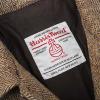
As demand rose, so did imitations. Cloth made elsewhere began to be sold under the Harris name, and the weavers and merchants of the islands realised that their reputation needed protecting. In 1909 the Harris Tweed Association was formed, and in 1910 it registered the Orb mark, a globe topped with a cross, which is stamped on every genuine length of cloth. The first formal definition of the cloth followed in 1934, and in 1993 the Harris Tweed Act established the Harris Tweed Authority and set the definition in law.

Handsewn Pure Virgin Wool

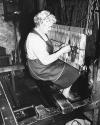
That definition is what makes Harris Tweed stand apart. By law, it must be made from pure virgin wool, dyed and spun in the Outer Hebrides, and handwoven by the islanders at their own homes. It must also be finished in the Outer Hebrides. The word handwoven matters here: each length is woven on a treadle loom by an individual weaver, working in a shed or a room in their own house, with the clack of the pedals a familiar sound in island crofting townships. The weavers' double-width Hattersley looms, many of them decades old, are operated by foot and hand, and no two weavers produce quite the same cloth. Traditionally, wool was dyed with local lichens and plants, and older Harris Tweed was famously said to carry a faint smell of peat smoke. Today's dyes are modern, but the cloth keeps its depth and richness of colour.

The value of the Orb mark is that it guarantees where and how the cloth was made. A buyer is not simply getting a warm wool fabric, but a product tied to a particular place, a particular community and a particular way of working. Most other tweeds, however good, are made in mills with power looms and can come from anywhere. Harris Tweed's reputation rests on being the exception.

The cloth has had its ups and downs. Production reached its peak in the middle of the twentieth century, then declined sharply as fashions changed and cheaper fabrics took over. By the early 2000s the industry was in serious difficulty and the number of weavers had shrunk dramatically. But a revival followed, helped by new mill owners, new investment and fresh interest from designers. Fashion houses and sportswear brands began to use the cloth, and Vivienne Westwood famously built a collection around it in the 1980s. Today Harris Tweed is woven in smaller quantities than in its heyday, but it is once again valued as a rare and carefully made cloth.

Style Inspiration

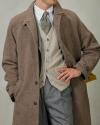
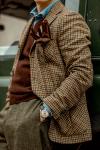
Tweed began as the rugged cloth of Scottish crofters, became the uniform of Victorian Highland estates, and is now a menswear favorite. Discover our assortment of classic blazers, casual jackets, and overshirts, along with contemporary accessories.

Tweed in Menswear Today

For much of the twentieth century, tweed meant two quite different things. To country people, it was practical clothing for the shoot, the farm and the river. To everyone else, it was increasingly the uniform of the absent-minded professor, with its elbow patches and a faint whiff of pipe smoke. By the 1980s and 1990s, tweed had a fusty reputation, and younger men who wanted to look modern tended to avoid it.

The change came in the 2000s, and it has been building ever since. Part of it was the broader heritage revival in menswear, when a generation of men began to value clothes with a story, from raw denim and waxed jackets to brogues and flat caps. Tweed fitted neatly into this world. Television and film helped enormously: Downton Abbey put the country estate back in the public imagination, Peaky Blinders made flat caps and heavy tweed three-piece suits aspirational, and Sherlock Holmes, in his various modern guises, kept the deerstalker and the tweed coat in circulation. Designers noticed, and tweed began to appear regularly on runways and in high street collections alike.

There are deeper reasons too. Tailoring has become more of a choice than a necessity. Now that most workplaces are casual, a man who puts on a jacket does it deliberately, and tweed gives a jacket personality that a plain navy blazer lacks. It is textured, rich in colour and gloriously forgiving of the odd crease, and it pairs just as easily with jeans and trainers as with flannel trousers and leather boots. This flexibility is a big part of its appeal: the same tweed jacket can be dressed up for a wedding or dressed down for a weekend walk.

A Sustainable Choice

Sustainability has played a part as well. As people grow wary of fast fashion, a cloth that can last decades starts to look like a sensible investment. Tweed is made from a natural, renewable fibre, it ages gracefully, and a good jacket can be repaired, altered and handed down. Buying a tweed garment now fits comfortably with the idea of buying fewer, better things. The provenance of cloth like Harris Tweed adds to this, giving buyers a clear story about who made it and where.

The way tweed is worn has changed a great deal. The Victorian sportsman wore it head to toe, in heavy, coarse cloths designed for cold hillsides, often in the form of knickerbockers or plus fours. The early twentieth century saw it move into town as the standard fabric for casual and weekend suits, and later it became associated with academia and the gentleman's country life. Now men wear it in pieces rather than whole outfits: a blazer, a casual jacket, a cap, a tie, or a pair of trousers mixed with other fabrics. Cloths are lighter and softer than before, cuts are slimmer, and colors range from the traditional heathers to brighter and more unexpected shades. Aesthetic trends such as "dark academia" and "old money" have given tweed a fresh audience among younger men, many of whom have no memory of the stuffy associations it once carried.

It is an odd twist that a fabric designed to disappear into a Highland hillside has become so noticeable. But perhaps that is the secret of tweed's staying power. It has been a crofter's cloth, a royal fashion, a sporting uniform, a professor's cliché and a designer's inspiration, and each time it has shed one identity and picked up another. Its fundamentals have barely changed: wool, wind, rain and the patient work of weavers. The jacket on the rack today, whether woven in a Border mill or on a treadle loom in a Hebridean shed, belongs to a story that is nearly two centuries old, and still being written.

Tags:Menswear, Style Guide, History of Tweed, Harris Tweed, Sustainability

Related Articles

Fabric Focus: Cotton Corduroy

Style Guides · October 11, 2026 · Christopher Gustafsson
Once nicknamed “poor man’s velvet,” cotton corduroy has traveled from the mills of Manchester to the racks of today’s best menswear labels. Discover how this ridged fabric is made, how it moved from workwear to campus classic, and why it’s enjoying a quiet comeback.
Read More

The Shaggy Dog: Shetland Wool's Enduring Sweater

Style Guides · September 24, 2026 · Christopher Gustafsson
The "Shaggy Dog" is a brushed Shetland wool crewneck that takes its name from its soft, fluffy texture. Originating in Shetland's centuries-old knitting tradition, it was perfected by mills like Jamieson's, which has spun, dyed, and knitted the wool itself for five generations. The sweater rose to prominence through 1950s American Ivy League style, worn over oxford shirts and under tweed jackets.
Read More

The Shawl Collar Cardigan: A Timeless Classic in Menswear

Style Guides · September 20, 2026 · Christopher Gustafsson
The shawl collar cardigan is one of menswear's oldest ideas enjoying one of its biggest moments. Named in part after the 7th Earl of Cardigan and finished with a rolled, unnotched collar borrowed from Victorian smoking jackets, this knitwear staple has moved from golf courses and Ivy League campuses into everyday rotation.
Read More