Skip to content

Express Deliveries & Easy Returns

Baltzar

William Lockie: the Enduring Legacy of Scottish Knitwear

Brand Stories · April 28, 2026 · Christopher Gustafsson

A weathered brass plaque engraved Wm Lockie & Co Ltd, Registered Office

Introduction

Tucked into the Scottish Borders on the banks of the River Teviot sits Hawick, a town whose name has been synonymous with fine knitwear for well over a century. Among the mills that built that reputation, few have done so with the quiet consistency of William Lockie. While countless competitors have shuttered their factories, sold off their production lines, or become little more than licensed names stitched onto garments made overseas, William Lockie has kept its knitting machines running in the same town, largely with the same families, since 1874.

A stone arch bridge over a river in a Scottish border town, with a turreted building behind

A Family Story Rooted in Hawick

The company traces its origins to William Lockie himself, born in 1835, who worked in the hosiery trade before seizing an opportunity to purchase manufacturing equipment from his former employer. In 1874, he set up production on Fore Row, the site that would later become Drumlanrig Square, and the business has occupied ground near that original location ever since, today sitting alongside the Slitrig Water, a tributary of the Teviot. Ownership has stayed remarkably close to home too: the Thorburn family, direct descendants of William Lockie, continue to run the company, and many of the skilled knitters, menders, and finishers on the factory floor come from families who have worked there for generations.

That continuity matters in an industry that has seen dramatic contraction. Hawick once supported around sixteen knitting mills; today only a handful remain, and several once-famous names in Scottish cashmere have either closed, been rescued by outside investors, or shifted their manufacturing abroad while continuing to trade on a heritage they no longer practice. William Lockie is frequently cited as one of the few Hawick mills that still does everything in-house, from raw yarn to finished garment.

Close-up of a multicoloured Fair Isle knitted vest worn over a blue shirt

Materials and Craftsmanship

William Lockie's reputation rests on an insistence on sourcing only the finest natural fibres and processing them with old-fashioned care. The brand works primarily in four materials: pure cashmere, lambswool, Super Geelong (sometimes called virgin wool, taken from the first shearing of specially bred Australian lambs), and camel hair, sourced from the undercoat of the two-humped Bactrian camel and left in its natural, undyed colour. These raw fibres are spun and dyed by long-established British spinners, including Todd & Duncan in Kinross and Hinchcliffe & Sons in Yorkshire, before making their way to the Hawick mill.

Once the yarn arrives, William Lockie's approach is defined by generosity and precision rather than speed. The mill uses more yarn per garment than many competitors and knits at a tighter tension, producing knitwear that is noticeably denser, smoother, and better at holding its shape over years of wear. Garments are typically described by their "ply," referring to how many strands of yarn are twisted together: one-ply pieces, such as those in the brand's lightest cashmere lines, use a single thread for a fine, lightweight feel, while two-ply collections twist two threads together for a thicker, more substantial garment.

In 1991, the company introduced Shima Seiki knitting machines capable of producing intricate intarsia patterns and textures that would once have required painstaking handwork. Rather than replacing tradition, this technology was folded into it: garments still pass through the same hand-finishing processes as before, with panels for the front, back, sleeves, and any trims knitted individually before being carefully linked and finished by hand. The result is a hybrid of modern capability and old-world attention to detail that the brand argues cannot be replicated by mass manufacturers.
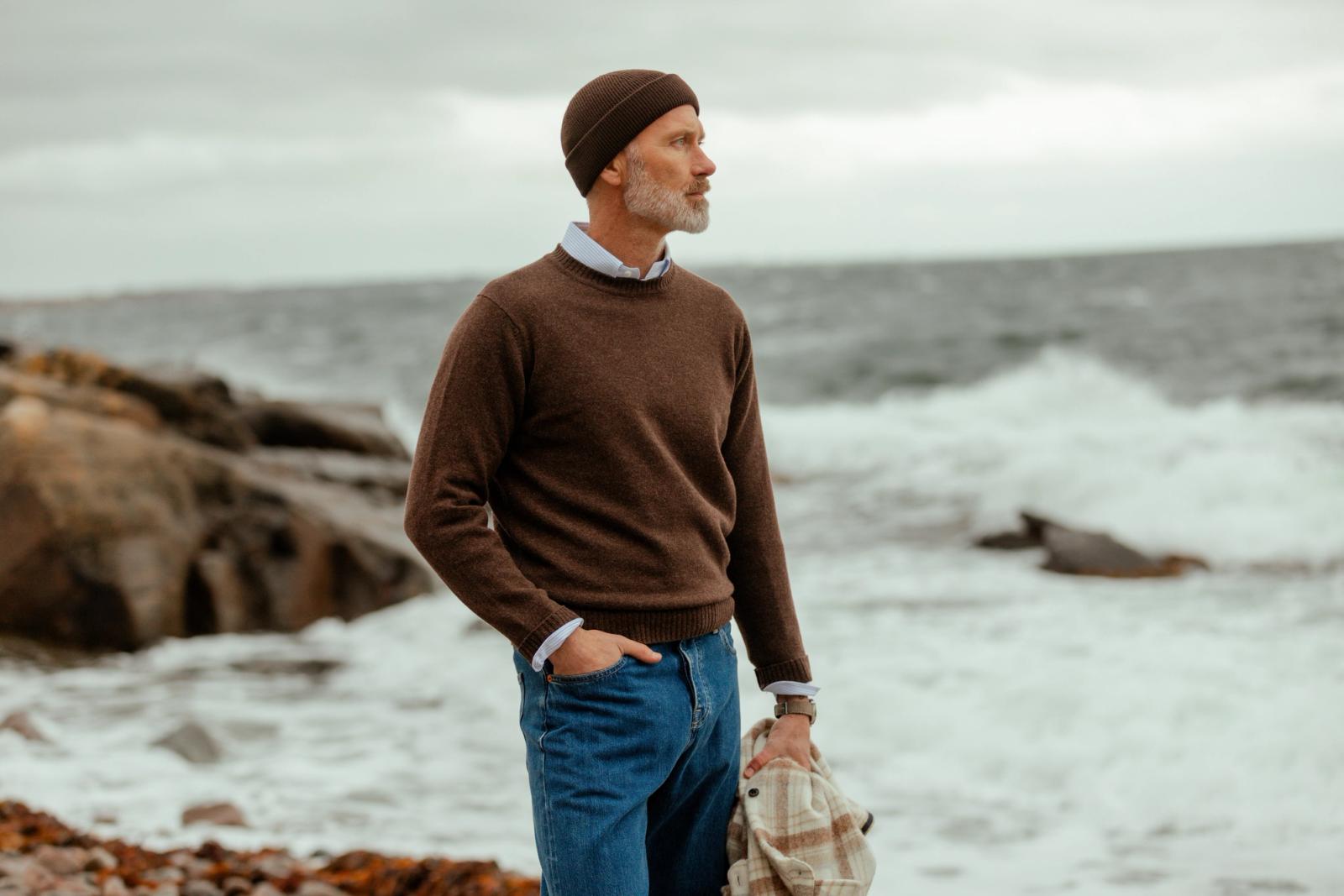
William Lockie

Premium knitwear made in Scotland using the finest lambswool and cashmere in a large variety of colours, including traditional blue, grey and brown, along with contemporary shades exclusive for the season.

Browse the collection
A man in a cream shawl-collar cardigan and white trousers in a hillside valley

Signature Pieces and Specialities

William Lockie's core reputation is built on classic knitwear silhouettes executed to an exceptionally high standard: crew neck and V-neck jumpers, roll necks, cardigans, and slipovers or vests, many organised into named collections that signal their fibre and weight (lighter one-ply cashmere ranges alongside heavier two-ply lambswool and Super Geelong lines). The brand is particularly celebrated for its cashmere, often described by admirers as among the last genuinely traditional cashmere still produced in Scotland, and for lambswool jumpers and shawl collar cardigans, traditionally made using patterns dating back to the founding of the brand.

Close-up of a rust-coloured V-neck sweater worn over a shirt and patterned tie

A Quiet Kind of Prestige

William Lockie has never chased the fashion spotlight in the way some of its more famous Hawick neighbours once did, and that restraint may be part of why it has survived while grander names have not. It has resisted the boom-and-bust cycles that come with chasing trends, instead building a loyal following among customers worldwide who value substance over branding. In an era when "heritage" is often a marketing label applied to products made far from where a brand began, William Lockie remains a rare example of a company still making its goods exactly where, and largely how, it always has.

A man in a navy shawl-collar cardigan, light blue shirt and jeans

Frequently Asked Questions

When was William Lockie founded?
The company was founded in 1874 in Hawick, Scotland, by William Lockie.

Is William Lockie still family-owned?
Yes. It remains under the ownership of the Thorburn family, direct descendants of the founder, and continues to employ workers from families with generations of ties to the mill.

Where is William Lockie knitwear made?
All William Lockie garments are manufactured in Hawick, in the Scottish Borders, where the company has operated since its founding.

What materials does William Lockie use?
The brand primarily works with pure cashmere, lambswool, Super Geelong (virgin lambswool), and camel hair, all spun and dyed by established British spinners.

What does "ply" mean in William Lockie knitwear?
Ply refers to how many strands of yarn are twisted together to knit a garment. One-ply pieces use a single thread for a lighter weight, while two-ply garments twist two threads together for a thicker, heavier result.

Tags:William Lockie, Premium Knitwear, Made in Scotland, Lambswool, Cashmere

Related Articles

Astorflex - Two Centuries of Italian Shoemaking Heritage

Brand Stories · September 1, 2026 · Christopher Gustafsson
Discover the 200-year history of this Italian family shoemaker, its handcrafted desert boots, sustainable materials, and stitchdown craftsmanship from Castel d'Ario.
Read More

Paraboot: a Century of French Shoemaking Heritage

Brand Stories · July 22, 2026 · Christopher Gustafsson
Paraboot is a French shoemaker founded in 1908 in Izeaux, near the Alps, by Rémy Richard. The brand became famous for the Michael, a Tyrolean-style derby launched in 1945.
Read More