Skip to content

Express Deliveries & Easy Returns

Baltzar

Albert Thurston: Two Centuries Holding Things Up

Brand Stories · November 11, 2026 · Christopher Gustafsson

History & Heritage

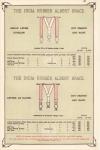
Albert Thurston brought his handmade braces to market in 1820 from an emporium at 27 Panton Street, Haymarket, London. The timing was no accident. Regency dandyism, led by Beau Brummell, had made snug, high-waisted, tightly cut trousers fashionable, and these needed support at the waist. The early design used tightly woven wool that formed an H across the wearer’s back. The straps were made from boxcloth wool, and this is the form of braces that was first mass produced.

Recognition came early. Thurston received an Honourable Mention at the Great Exhibition of 1851 for the standard of its products. Over the following decades, braces were standard male dress, because the high-cut trousers of the era made a belt impractical. Then came the First World War, when men grew used to uniform belts, and the brace’s dominance began to fade.

The company’s own story also includes a change of address. A 1994 trade source records that although the firm was founded in London in 1820, it has traded from Leicester since 1984, when Richard Kew bought the Thurston name. Leicester, a city with a long textile and elastic-weaving tradition, has been the working home of the brand ever since. The name stayed British, and the making stayed in England.
Craftsmanship - How a Pair of Braces Is Made

Thurston is credited with introducing adjustable braces. When he opened on Panton Street, he introduced the first adjustable braces, which laid the foundation for the design still worn today. That adjustability, a slide-and-buckle mechanism that lets the wearer set the length, is the brand’s defining innovation and the reason a pair can fit different torsos.

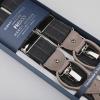
Today, the braces are produced in small batches in Leicester and Northampton, hand-finished by skilled craftsmen, and fitted with calfskin loops and solid brass clips.

1. The webbing. Everything starts with the woven strap. Modern Thurston braces use elastic webbing in patterns such as herringbone and ribbed weaves. One 35mm style has herringbone-patterned elasticated straps with coloured, vegetable-tanned leather trim. The limited editions go further. They are jacquard-woven in pure silk, wool flannel or pure linen.

2. Cutting and shaping. The webbing is cut to length and the back is shaped, as a Y or an X, so the load spreads evenly across the shoulders.

3. Hardware and leather. Metalwork, including buckles, adjusters and clips, is attached to the straps. The limited editions are finished with full-grain leather ends and polished gilt fittings.

4. Finishing. The ends are hand-stitched, the pair is checked, and it is boxed. Many Thurston styles are 2-in-1, so they come with both clips and leather button tabs. The wearer chooses how to attach them, and the choice matters. Button-on is the traditional, more formal method.

Albert Thurston

Browse our seasonal selection along with classic staples for festivities, weddings and everyday wear.

Browse the collection

The Collection: Staples & Seasonal Highlights

The core of the range is deliberately plain. The workhorse is the 35mm elastic brace in herringbone, ribbed, or plain weave. It comes in several useful colours, with leather trim and metal fittings that can be had in nickel or brass. Burgundy styles, for example, have nickel details with vegetable-tanned dark brown leather. These are the pairs that go under a navy suit or a tweed jacket without a fuss. Alongside them sit the leather-end and button-on braces for formal wear.

The seasonal element works differently from most fashion houses. Instead of following runway calendars, Thurston releases limited editions, with designs woven in limited runs. These include wool flannel or tweed braces during autumn-winter, along with Irish linen in spring-summer.

Recognition & Outlook

Thurston’s standing in menswear rests on a long list of wearers. The brand has made braces for kings, presidents and royalty. Screen appearances have kept it in the public eye. Red braces became synonymous with finance after the 1987 film Wall Street. That film’s Gordon Gekko, played by Michael Douglas, is shown in Albert Thurston suspenders. Daniel Craig’s Bond also wore the brand in the poker scene in Casino Royale, along with several other Hollywood productions, including Darkest Hour, Knives Out, American Psycho, and The Great Gatsby.

The outlook is more interesting than the nostalgia suggests. Belts have dominated for a century, yet braces have found a steady audience among tailoring enthusiasts. Suits with a high rise and a clean waistline, with no belt loops to break the line, sit best with them, and the interest in craft and provenance suits a brand that has made things in England for two hundred years. The limited-edition model gives Thurston a way to refresh the line each year without compromising the classics. The conclusion is simple. Thurston has lasted because it did one thing, and did it well enough that the product barely needed to change.

Frequently Asked Questions

When was Albert Thurston founded?
In 1820, at 27 Panton Street, Haymarket, London.

Where are the braces made today?
In small batches in Leicester and Northampton, England.

Are they elastic or fixed length?
Most current styles use elastic webbing with an adjustable length. Many are 3.5 cm wide and come with both clips and leather straps.

Should I choose clips or buttons?
Buttons are the traditional choice and look best with tailoring, but they require buttons sewn inside the waistband. Clips are convenient and good for casual wear. The 2-in-1 styles let you choose either.

Can I wear braces and a belt together?
Style convention says no. Choose one, and wear braces with trousers cut for them.

How do I get the right length?
Most styles adjust, so the fit is usually forgiving. Check each product’s listed length and width before buying.

Tags:Albert Thurston, Braces, Suspenders, Handmade, England

Related Articles

Kamakura Shirts: A Japanese Shirtmaker with Ivy League Roots

Brand Stories · November 2, 2026 · Christopher Gustafsson
In 1993, a family opened a small shirt shop above a convenience store in Kamakura. Three decades later, Kamakura Shirts is known worldwide for Ivy-style button-downs made in Japan with fine yarns, 21-stitch seams and shell buttons. This is the story of the brand’s heritage, craft, collection and future.
Read More

Filippo De Laurentiis: Italian Knitwear Built on a Family Loom

Brand Stories · October 29, 2026 · Christopher Gustafsson
Filippo De Laurentiis grew out of a family knitwear tradition in Italy’s Abruzzo region. This story traces the brand’s roots, its knitting craft and its choice of fibres, from merino and cashmere to cotton and linen. It also covers its core staples and where the label is heading after a major investment.
Read More

Ring Jacket: Where Japanese Craft Meets Neapolitan Ease

Brand Stories · October 28, 2026 · Christopher Gustafsson
In 1954, an Osaka insurance salesman frustrated that ready-to-wear never matched bespoke decided to make it himself. Today, Ring Jacket is known for soft, full-canvas jackets, cloth developed exclusively with Japanese mills, and a quiet debate over what “Japanese tailoring” really means.
Read More